

Guignard Kyoto Collection
Diptych Lotus | Hine Taizan 日根對山 | 1813-1869 (presumably 1860)
Diptych Lotus | Hine Taizan 日根對山 | 1813-1869 (presumably 1860)
Couldn't load pickup availability
Hine Taizan is an outstanding painter from the Osaka region. Painters from Osaka found it increasingly difficult to make a name for themselves throughout Japan compared to those from Kyoto, where the definition of ‘good art’ was established. Taizan therefore moved to Kyoto to ensure he kept pace with high art. Nevertheless, he continued to be regarded as a painter from Osaka, as evidenced by his surname, which he never disowned: ‘Hine’ is a village south of Osaka.
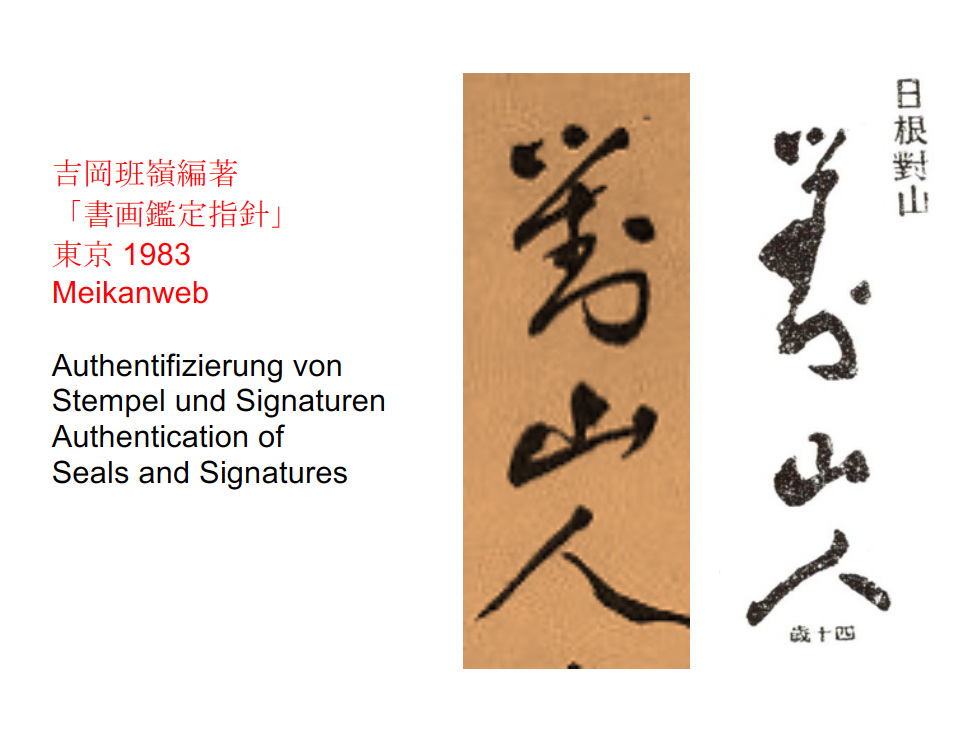
This two-panel painting was originally a diptych, which has been combined here into a double painting. The reason for this combination was to emphasise how ingeniously, in this composition, the lotus blossoms, their stems and leaves engage in a dialogue with one another across the picture borders in the extreme vertical format. The result is a marvellous interplay of focal points, shifting from one picture to the other and back again. Taizan also integrates his large signature into this dialogue. On the left, he places it in the centre of the image, and on the right, in the upper section. This creates an upward momentum in the composition, which is both highly original and unusual.
Taizan mastered various styles, as was expected of a painter of his stature. Here, he chose a decidedly rustic, coarse-grained paper and adapted his brushwork to suit it. Even the delicately opening blossom displays a sketch-like, improvised stroke; yet it is the leaves in particular that are imbued with a truly dramatic sense of transience.
The seals could not be verified, which is hardly surprising, given that over 70 seals by this painter are known… He seems to have enjoyed creating and using new seals.