

Guignard Kyoto Collection
Double folding screen: Pair of Pheasants | Ikegami Shūhō (attr.) 池上秀畝 | 1874–1944
Double folding screen: Pair of Pheasants | Ikegami Shūhō (attr.) 池上秀畝 | 1874–1944
Couldn't load pickup availability
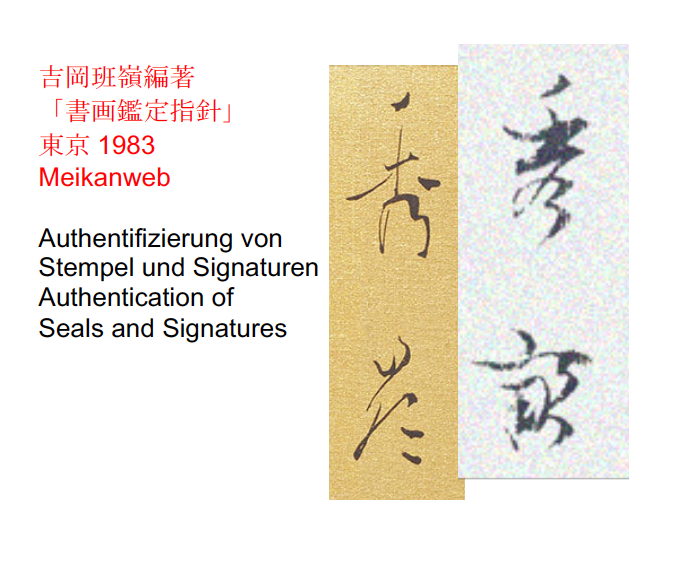
Ikegami Shūhō is presumed to be the painter of this double folding screen, but the signature is not entirely beyond doubt; therefore, the work should be considered “attributed.” The quality of the composition and the delicate execution of the details unquestionably meet the standard of this great nihonga painter. Nihonga literally means “Japanese painting.” Yet behind this term lies a stylistic movement that was aware of being exposed to all manner of artistic influences in the 20th century—from Europe and its own history—and therefore sought, through free choice, to create a new Japanese idiom. For these artists, it was a question of identity: They did not want to repeat either their own history nor Western art, but rather to create something of their own that they perceived as “Japanese” in a new way. (As a rule, when Japanese people wish to acquire classical art, they usually purchase nihonga paintings. The stylistic movement thus struck the right chord.)
The painting on this folding screen, however, follows the classical tradition very closely. The great 18th-century master, Maruyama Ōkyo (1733–1795), is unmistakably present in this work. Ōkyo, too, created gold folding screens with a realistic approach and reduced perspective to mere markings.
On this double folding screen, however, a sense of depth is created by the positioning of three pine trees and the two pheasants. Yet, as with Ōkyo, the ground is completely unrealistically golden. The tree bark, on the other hand, is almost hyperrealistic, as is the fine plumage of the pheasants. The relationship between the two birds is also rooted in tradition. It is not only the difference in the color of their feathers that reveals the pheasants’ sexes: The male stands in front, calling out boldly into the distance; the female hides shyly behind a pine trunk and listens only in admiration… This is the classic gender dynamic of male and female, as found in every depiction of humans and animals in Japan during the Edo period (1603–1867) and well into the 20th century.