

Guignard Kyoto Collection
Football Kemari 蹴鞠 | anonymous | 17th Century
Football Kemari 蹴鞠 | anonymous | 17th Century
Couldn't load pickup availability
The game of football can be found in various ancient cultures around the world. For Japan, the ancient version of Chinese football was certainly influential. However, it was never really practised as a sport in Japan, but remained within the context of bugaku. Bugaku means ‘court dance’, as it was introduced to Japan from the mainland in the 8th century. The view that bugaku consists solely of dances is too narrow; it includes theatrical pantomimes in the form of short dramas, as well as repertoire pieces with a sporting character, such as field hockey or, indeed, football. In football, known as kemari, only a few participants are involved on the field – here on the screen there are four. The rules of football are, in principle, limited to the stipulation that the ball must not touch the ground. For the history of kemari in Japan, see the following link:
www.fifamuseum.com/de/entdecken/fifamuseumplus/blog/origins-kemari-in-japan
However, the folding screen is not only remarkable for the football scene in a palace garden. In the hall to the left of the garden, a dance scene is unfolding that is anything but courtly and stiff. Leaning casually against a pillar, a dandy plays the shoulder drum (such ease does not conform to a musician’s code of decorum), and he watches the young dancer for whom he is playing with obvious admiration. A red carpet has been laid out on the veranda, upon which another young man is lounging comfortably, with little regard for propriety. The atmosphere of this relaxed scene of merriment also sets the tone for the semi-sporting scene of merriment outside in the garden.
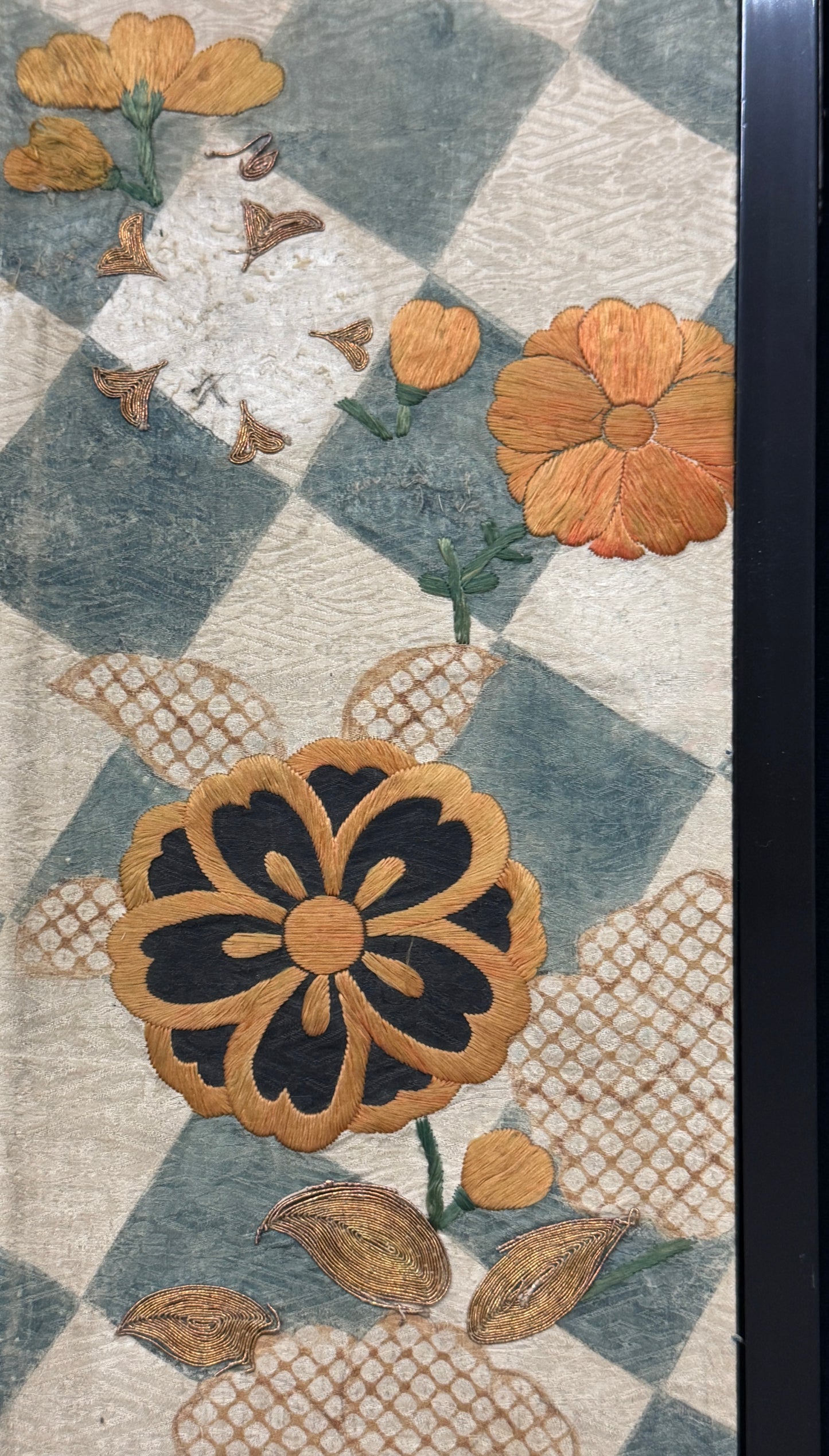
The design of the double-panel screen is remarkable. The division between the garden and the dance hall runs across the composition at an angle of approximately 45 degrees. The yellow garden stands in stark contrast to the semi-dark interior of the hall. The garden design begins in the top right-hand corner and runs at the same angle into a triangular border of the picture frame. On the right-hand side, concealed by exquisite embroidery, this develops into a diamond pattern. On the other side of the picture we find purple silk – the exclusive colour of the nobility.
With this magnificent framing on the left and right, the exact locations of these two scenes are thus clearly indicated.