

Guignard Kyoto Collection
Thunderstorm in the Country | Hanabusa Itchō | 1652-1724
Thunderstorm in the Country | Hanabusa Itchō | 1652-1724
Couldn't load pickup availability
Hanabusa Itchō stands out as an outsider in Japanese art history. He came from a good family – his father worked as a doctor in the service of various princes. At the age of 15, Itchō entered a monastery, but was soon shown the door due to his unbridled temperament. He then became an apprentice to Kanō Yasunobu, one of the most respected painters of the Kanō school. However, his rebellious spirit refused to conform to the studio’s strict artistic guidelines, and so he was soon expelled. Later, in 1698, he was embroiled in a scandal when he mocked the shōgun’s courtesan; for this, he was sent into exile.
Itchō was, however, highly talented, including as a poet, which earned him the friendship of Bashō. He often hung about in the red-light districts and loved the bohemian life. This meant he no longer had any prospect of princely patronage, so he tried his luck with bourgeois art lovers. On the one hand, this freed him from established artistic aesthetics; on the other, it helped him to explore new motifs.
Farmers running headlong away, gesticulating wildly, during a downpour in a thunderstorm are certainly not a classical motif in the 17th century. This liveliness in the figures’ movements and facial expressions was certainly closer to bourgeois taste than to that of the nobility. Yet the depiction of the clouds, which with their jagged edges almost resemble slate, is also highly unusual, and it is rare for actual lightning to be painted in scenes of thunderstorms. These are all elements that Itchō invented himself; as a free spirit, he was answerable to no one.
The mounting may no longer be quite perfect, but its colour scheme harmonises with the faded blue at the top and bottom (jōge), and as a whole it is irreplaceable. The somewhat old-fashioned turned finials on the lower picture rail have also been left in place.
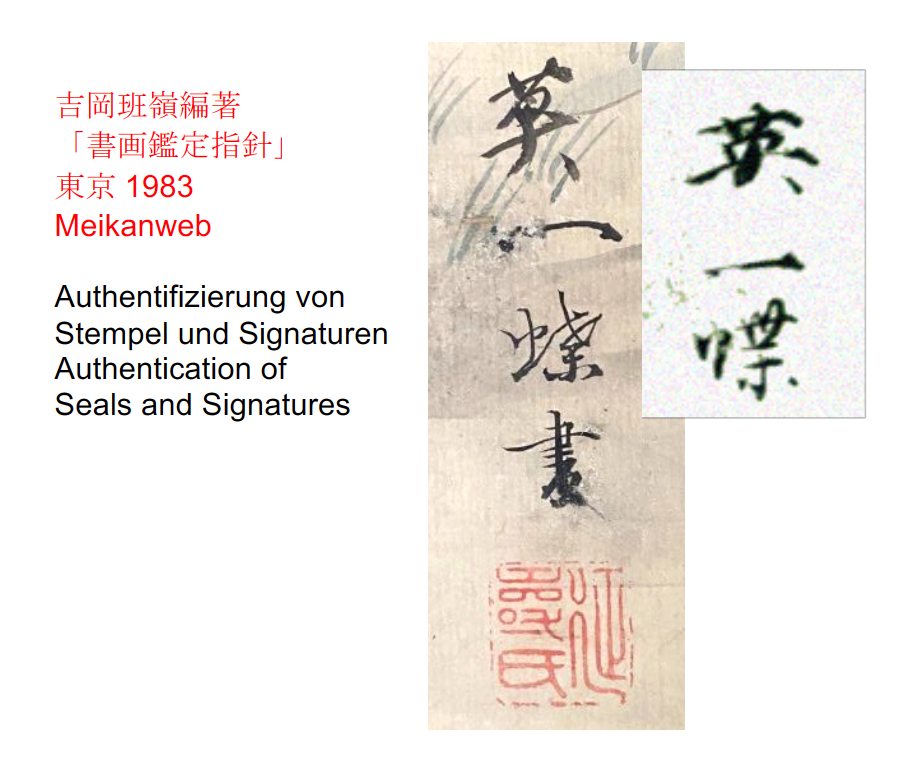
Given the wide variety of Itchō’s signature styles, the signature is considered authentic; however, the seal could not be located.