

Guignard Kyoto Collection
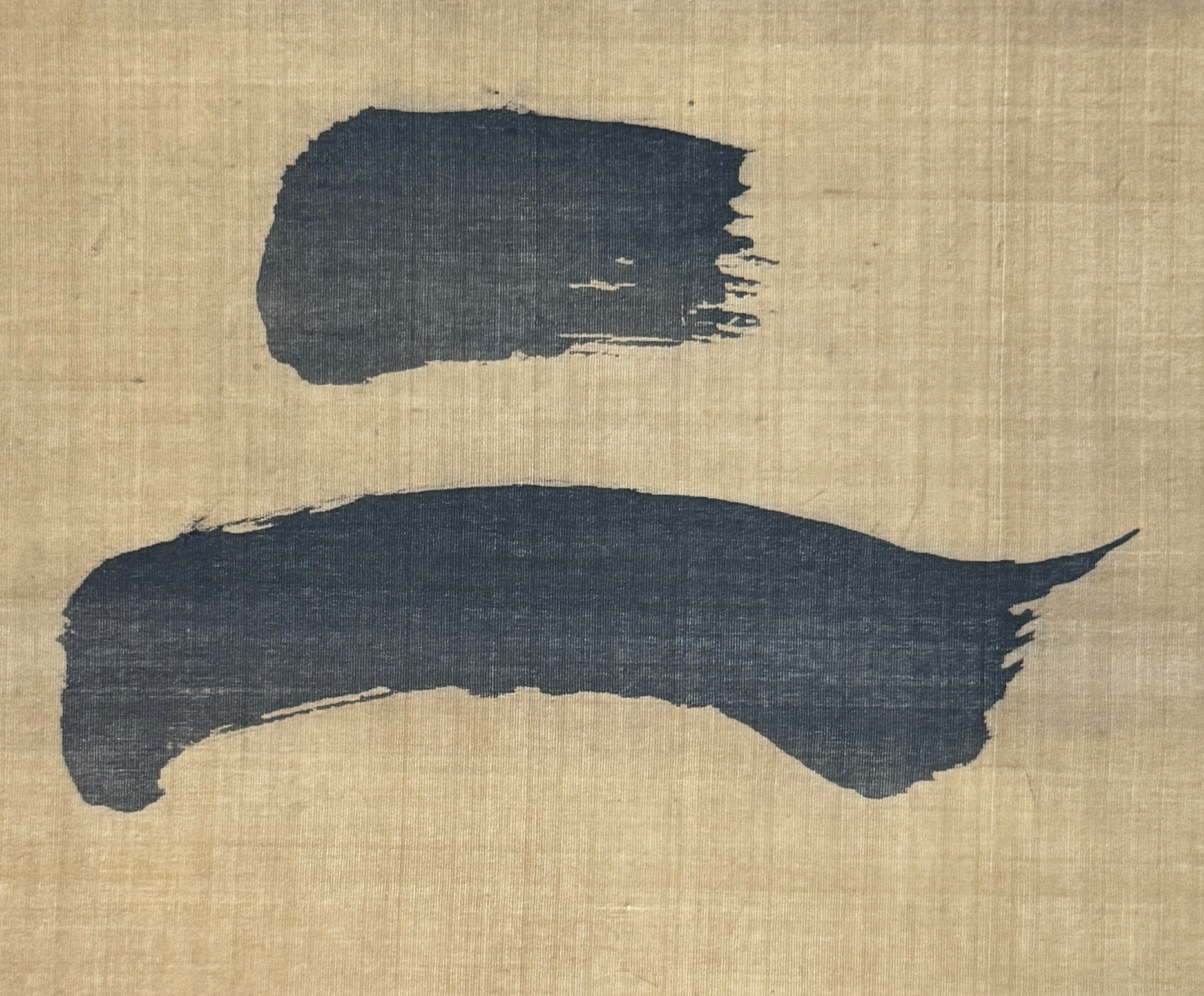
Calligraphy "No Duality" | Sakai Hōitsu 坂井抱一 | 1761-1828
Calligraphy "No Duality" | Sakai Hōitsu 坂井抱一 | 1761-1828
Couldn't load pickup availability
Sakai Hōitsu is the most important Rinpa painter of the late 18th century. This school began as a new direction in art history a hundred years before Hōitsu with Tawara Sōtatsu (1570-1640) and other artists who came from the court culture. Court painting had cultivated a distinctly different style for centuries than the painters of the temples and samurai society. However, when the court lost much political and economic power in the late 16th century, a group of artists separated from this institution and founded an artists' colony in Kyoto outside the palace. Equipped with their rich learned tradition, they created an innovative style primarily for the emerging urban bourgeoisie. Sakai Hōitsu is considered the main exponent of the 3rd generation of this school – primarily because he was a great admirer of Ogata Kōrin, the exponent of the 2nd Rinpa generation. He also wrote treatises about him: "One Hundred Leaves by Kōrin" and "Summarized Painting Style of the Ogata Style," thereby institutionally consolidating the exquisite new art direction for future generations.
Hōitsu is primarily known as a painter, but he was also a significant calligrapher, with most of his calligraphies characterized by soft, flowing strokes. This calligraphy is unsigned, but it is highly likely to be his. Hōitsu, a descendant of a wealthy princely family from Himeji, was born in Edo (Tokyo) and became a priest at the age of 36. This calligraphy has a strong Buddhist aspect. The script style is the "seal script" from ancient China and appears even deeper and more meaningful in this form than when written with normal characters. The text features four characters, which does not correspond to the five-character norm of a calligraphy line:
不二法門 fu ni hō mon "Not-two-laws-gate," i.e., "No Duality."
We know various principles of duality in Asia: Yin-Yang (Chinese), "Pure-Impure" (Shintō), Illusion-Reality (Nō theater), Good-Bad, etc. However, Zen meditation strives to overcome duality and aims for one to reject or overcome the comparison of opposites, or generally any discourse, and only recognize and accept "The One." This is the teaching of "Non-Duality" that Hōitsu addresses here.