

Guignard Kyoto Collection
Calligraphy “Body” 身 | Kōsetsu Sōryū 江雪宗立 | 1595–1666
Calligraphy “Body” 身 | Kōsetsu Sōryū 江雪宗立 | 1595–1666
Couldn't load pickup availability
Kōsetsu Sōryū was a prominent Rinzai priest from Izumi in what is now Osaka Prefecture. He was soon able to study calligraphy under Takuan, who was undisputedly regarded as the foremost priest-calligrapher of his time. For a Zen priest, he had an impressive career: at age 50, he became abbot of Daitokuji, the temple complex in Kyoto that for centuries was regarded as the major center for Zen calligraphy. After his death, Emperor Go-Sai bestowed a posthumous honorary title upon him.
His calligraphic works are often quite challenging. Even the first character in this piece is not immediately understandable. It is the character mi 身, meaning “body.” Its stylization is artistically original. This can be said in part because the same character appears in the adjacent text as the first character of the third line. There, it is written in the standard form, immediately legible to any Japanese person. In general, this text poses no problems for the reader; it is only the content that is profound in connection with the large central character of the calligraphy.
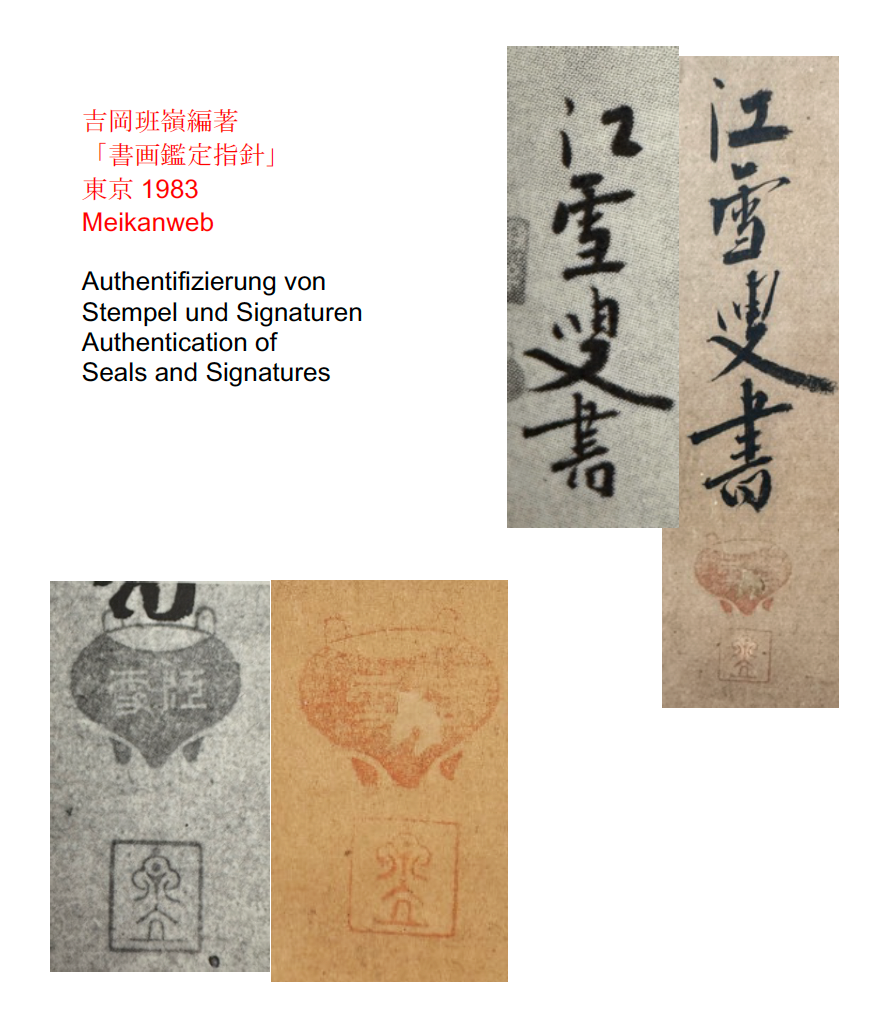
It reads: A monk asked the Zen priest Linxi Jingtuo*: “How do I experience the true Dharma of the 有僧問林渓脱 禅师如何是法 身脱答曰四海五 湖宾 Buddha?” The master replied: “Be a guest of the Four Seas and Five Lakes.” (The last line is the signature 江雪叟书).
So what is the significance of the character 身 ? Today, this kanji is not particularly mysterious, but here, in the Zen context, it refers not only to the physical body but to the unity of the physical and spiritual. Master Linxi Jingtuo`s exhortation thus means: Go through the world and face its physical and spiritual demands in every moment. Then you can truly exist as one mind-body, merging completely and holistically into the world, as is the ideal of the Zen monk.
*The monk Linxi Jingtuo (also known as Yingzhou Linxi Tuo) was a Chinese Zen master of the Yunmen School (雲門宗) who lived during the Northern Song Dynasty (960–1127), more specifically in the 10th and 11th centuries.