

Guignard Kyoto Collection
Carp | Itō Jakuchū (attr.) | 1716-1800
Carp | Itō Jakuchū (attr.) | 1716-1800
Couldn't load pickup availability
Itō Jakuchū, along with two other painters (Nagasawa Rosetsu and Soga Shōhaku), is counted among the “Three Eccentrics” of the 18th century. During this era, Maruyama Ōkyo (1733–1795) was regarded as the epitome of artistic excellence. Ōkyo’s great achievement was his engagement with European art, which was difficult to access at the time. He employed Western perspective (but only when it appealed to him artistically), conducted studies of nature like a Renaissance artist, and masterfully covered nearly all the subjects that interested Japanese painters of the time.
He exerted his greatest influence through his realism - even in the 19th and early 20th centuries, his approach, based on meticulous observations of nature, remained decisive (not to say burdensome) for most painters in their work.
However, there were three distinctive figures who defied Ōkyo’s unspoken aesthetic dictates. Jakuchū found various ways to challenge the ideal of beauty embodied in Ōkyo’s art. A major retrospective in 2000 at the National Museum of Kyoto astonished everyone with the immense richness of the stylistic forms that Jakuchū had invented.
In ink painting, it was above all the daring graphic compositions that amazed viewers - and which are equally fascinating in this depiction of a carp. The entire head is rendered in a very expressive and dynamic manner, yet is far removed from Ōkyo’s naturalism. The virtuosity of the brushwork in the fins and the sensitivity with which the scales are rendered are unsurpassed.
Added to this is the formal treatment of the vertical format: only the front third of the carp and - in the lower part of the painting - its tail extend into the frame. A few fronded strands of seaweed suggest the pond in which the carp is swimming.
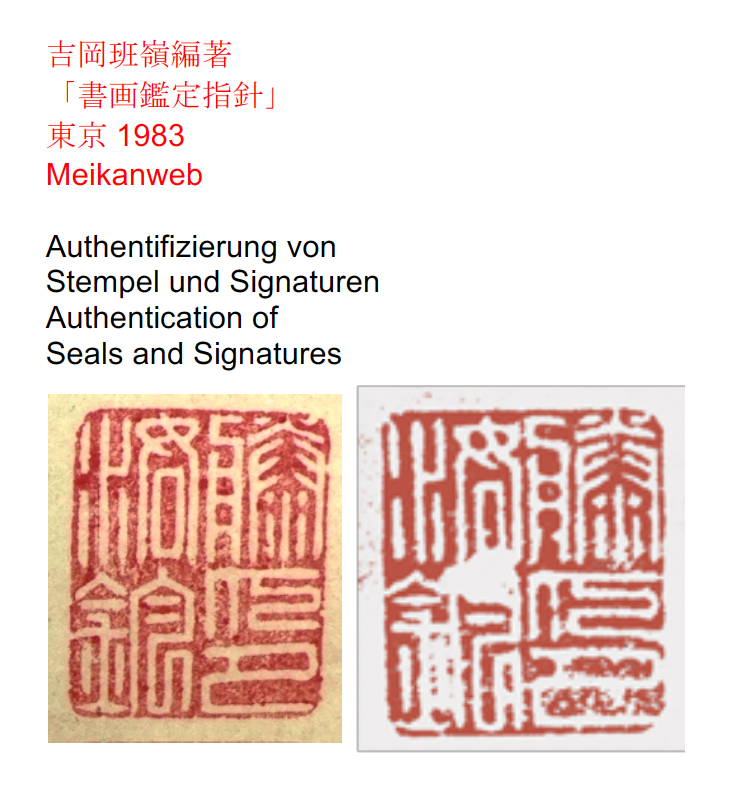
The painting’s signature is somewhat problematic in that only a few of Jakuchū’s works are signed with a single seal - the painter did not sign many of his works (which is not a problem in itself), but he usually applied two seals. The existing seal is perfectly acceptable, and the quality of the painting is so high that its authorship can be considered certain. Nevertheless, the painting should be classified here only as “attributed,” since it has been remounted and the original box is no longer available.