

Guignard Kyoto Collection
Landscape | Hashimoto Gahō 橋本雅邦 | 1835–1908 (1905) | Kawai Gyokudō 川合玉堂 | 1873–1957
Landscape | Hashimoto Gahō 橋本雅邦 | 1835–1908 (1905) | Kawai Gyokudō 川合玉堂 | 1873–1957
Couldn't load pickup availability
Hashimoto Gahō is regarded as one of the great innovators of Japanese painting at the end of the 19th century. This was a turbulent period in Japan. The island nation was being swept away by cultural, political and social upheaval. Finding a compass for the future suddenly became difficult in many aspects of life.
In painting, artists were confronted with new techniques, new motifs and entirely new perspectives, which demanded an immense intellectual effort to come to terms with. Japan could, after all, already look back on a rich, thousand-year history of art and had to find a way to create contemporary works without betraying its own heritage.
One significant five-hundred-year-old legacy was ink wash painting, which had no equivalent in Europe. Gahō, in particular, grappled with this problem. Simply painting ‘as in the past’ was certainly not the answer, but how could one draw on the treasure of one’s own history whilst still creating something ‘modern’?
In this veduta, Gahō takes the classical seascape as his starting point – a bay in the distance and a peninsula in the foreground. In principle, there is nothing revolutionary about this. Yet if one looks closely at how the bay is painted, one senses that this was not how artists painted from the 15th to the early 19th century. For the bay, Gahō chooses a very wet, broad brush, in whose brushstrokes the subtle vibrations of the painting hand are discernible (from the perspective of tradition, this is ‘impossible’). On the left, at the start, where the brush still holds the most water, he immediately followed the ‘bay stroke’ by painting pine trees, which blur on the paper due to the moisture, creating the illusion of a haze. (This tarashikomi technique originates from the Rinpa school – and thus does not belong to the ink-wash painting tradition). The pine trees at the front of the peninsula then appear perfectly distinct by contrast – even though they are nothing more than skilfully arranged dabs.
The two ships off the peninsula are also merely three horizontal strokes with a few dots on them. Further down, however, another ship is moving, larger and more realistic – here, a stooped boatswain is clearly rowing. All these details lend the picture atmosphere and a sense of depth, which radiate out into a vast ‘emptiness of the sky’.
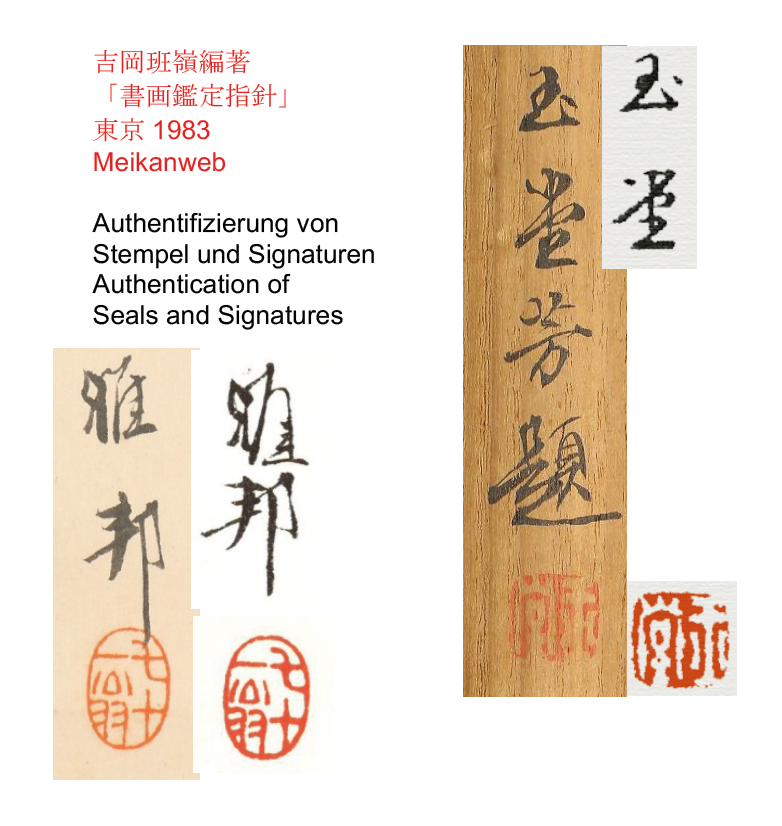
The picture is mounted on extremely precious gold silk, probably by Gahō’s pupil and great admirer, the highly esteemed painter Kawai Gyokudō, who also created, signed and sealed the box.