

Guignard Kyoto Collection
A Pilgrim's Staff | Tōrei Enji 東嶺円慈 | 1721-1795
A Pilgrim's Staff | Tōrei Enji 東嶺円慈 | 1721-1795
Couldn't load pickup availability
Tōrei Enji received a monastic education as a child and trained as a Rinzai priest. At the age of 23, he became a disciple of Hakuin, who is considered the great innovator of Zen Buddhist painting. Although Tōrei is considered the spiritual and artistic heir of Hakuin, he refrained from using his master's sometimes almost grotesque textual and graphic style of expression.
A priest's pilgrim's staff is a popular Zen motif. It is treated in many different ways, although it is actually just a downward stroke. Such a staff is gnarled at the top to provide a grip for the hand – otherwise it has no distinguishing features. For the painter, therefore, it is only the handle and the straight staff that serve to formulate an idea. This challenges the viewer, who must perceive these two aspects of the motif carefully and thoughtfully in their treatment:
The brushstroke at the top of this picture is weighty. The small white opening in the knob can be interpreted as meaning that Tōrei made a semicircular movement starting on the left. This helped him to build up energy, which he then shook out, as it were, by pulling the brush down. The shaking is revealed by the five wavy lines on the left, on the thumb side of his brush handle, i.e. where the power in the hand is located. This force soon diminishes—the painting tempo quickens as the stroke tapers and the ink trace becomes fibrous. But this accelerando is soon followed by a ritardando. The stroke widens again, ending calmly and roundly with a pleasantly soft weight.
What does this painting process express? Could we not understand the downward stroke in its processuality as a reflection of an inner descent, as a release of tension by sliding down into the spiritual base of the body, where the person is grounded and feels calm, i.e., the place where ki 氣is located (in the solar plexus below the navel)? With this letting go and deep relaxation, everything that matters is said in Zen style with a single stroke. The saying on the left and right of the staff 此わろを恐るる人は極楽へ “Those who honor this staff will find the way to Nirvana” is therefore very coherent and meaningful.
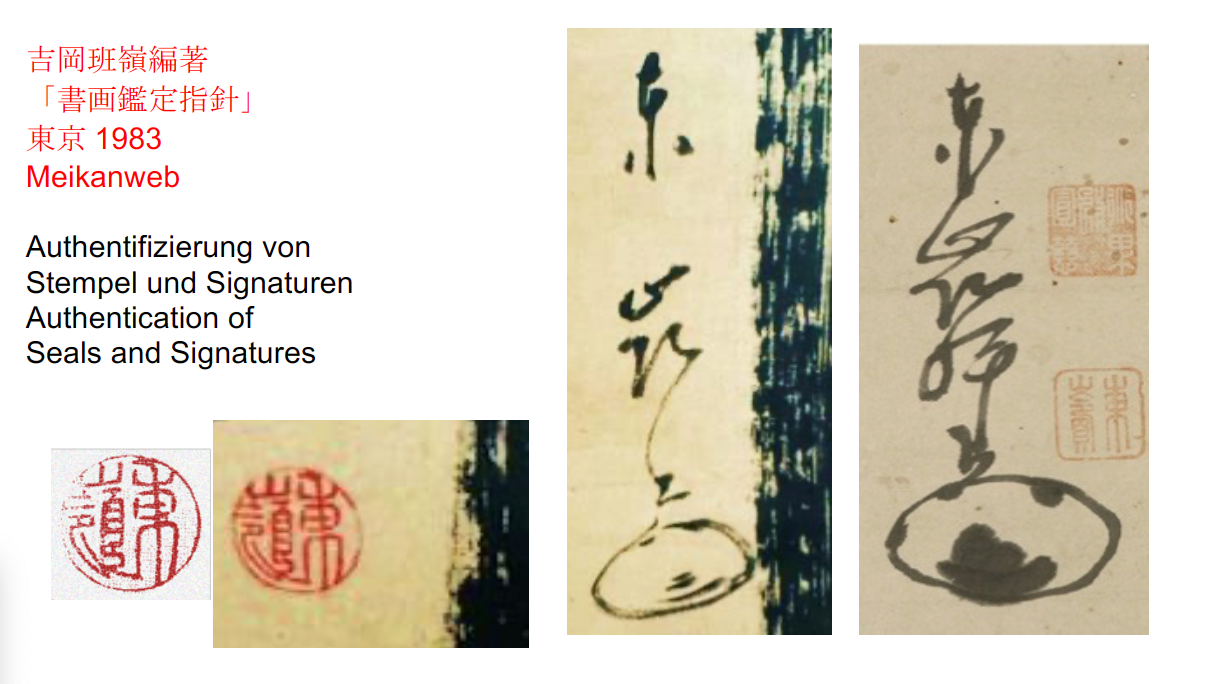
The finely crafted box (inscribed inside and out) was designed by the famous calligrapher Takeda Mokurai (1854-1930). It is instrumental in proving the authenticity of this painting.