

Guignard Kyoto Collection
Birds in winter with camellias | Kanō Sanraku (attr.) 狩野山楽(伝)| 1559-1635
Birds in winter with camellias | Kanō Sanraku (attr.) 狩野山楽(伝)| 1559-1635
Couldn't load pickup availability
Kanō Sanraku's mindset remained firmly rooted in the 16th century, although the second half of his life extended into the 17th century. He was a student of Kanō Eitoku, who served the shoguns Oda Nobunaga and Hideyoshi with art in the 16th century, and remained true to Eitoku's painting tradition.
In this winter scene, Sanraku chose two birds that are particularly common in the art of the Muromachi period (1336-1573). It is (presumably) the long-tailed tit, although in paintings of that time the coloration of the belly often shows a red that is not ornithologically typical of these birds. Long-tailed tits were usually depicted in pairs, huddled together in the cold. Sanraku thus drew on a well-established motif.
This also applies to the other bird on the right, a brown-cheeked bulbul, which feeds on camellia nectar. It is thus a symbol of approaching spring, because camellias bloom in Japan in winter, and such feeding (which is not directly a subject of the artwork here) heralds new, awakening life.
The reason for the long-tailed tits' red bellies is surely for color balance – they are meant to provide a counterpoint to the intensely red camellias on the left. The green of the camellia leaves seems somewhat unusual. This has chemical reasons, as the color green (most likely derived from malachite) has always been problematic in ancient Japanese art.
This painting style is fundamentally ink painting, but even in the first generation of the great Kanō school, colors were sometimes added to the black and white paintings. The paintings of the school's founder, Kanō Motonobu (1434-1530), are famous examples of this.
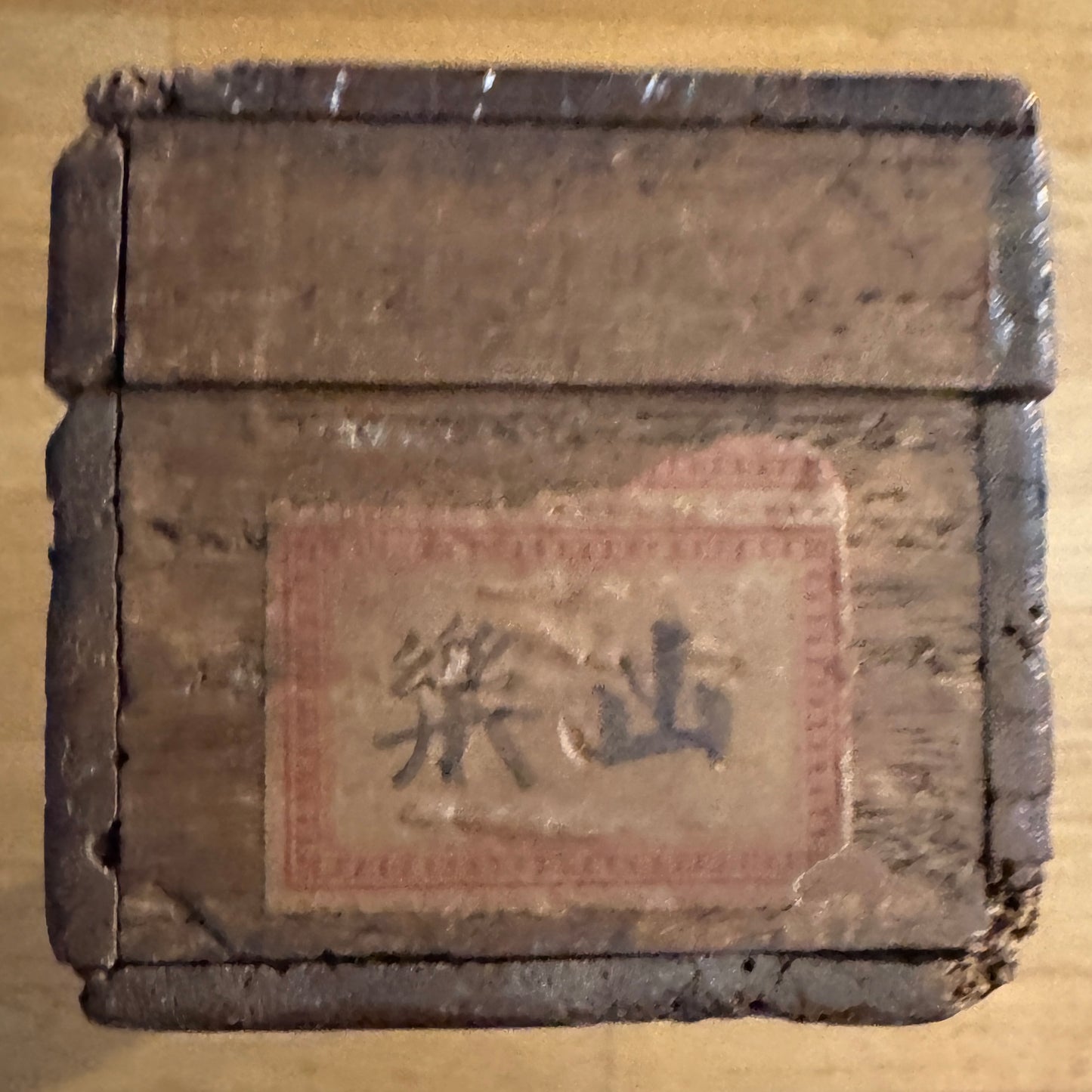
The picture is unsigned and unstamped, which was not uncommon at the time. The old box bears the name Sanraku, which at least justifies an attribution.