

Guignard Kyoto Collection
Twelve Monthly Pictures 四季図(12幅) | Yoshimura Kokei 吉村孝敬 | 1769-1836 (only to be purchased as series)
Twelve Monthly Pictures 四季図(12幅) | Yoshimura Kokei 吉村孝敬 | 1769-1836 (only to be purchased as series)
Couldn't load pickup availability
Yoshimura Kokei is among the "Ten Best Students of Maruyama Ōkyō (1733-1795)." This has been a distinction since in the 19th century, as at least 50 students are documented by name, and there were certainly dozens more talented individuals who studied in Maruyama's studio—one of the largest in the 18th century. Although his father was also a professional painter, Kokei apprenticed with Ōkyō to further his career. Together with his father, he received a commission to paint the sliding doors at Nishi-Honganji, one of Kyoto's most important temples, and the temple is said to still possess many of his works today.
What could one learn most from Ōkyo? Virtually everything, for this genius, who excelled in every discipline except calligraphy (a field he rarely attempted), attracted the attention of all art lovers in Japan primarily through his striving for realism, or even naturalism. This is also evident in these monthly paintings by Kokei. Yet, as with his master, the poetic rendering of the essentially true-to-life subject matter remains a crucial element in Kokei's work.
In this series of paintings, Yoshimura Kokei cultivates a refined style characterized by understated color – an approach typical of sophisticated Kyoto taste. The primary colors are brown, beige, and gray; only rarely is a more vibrant accent ventured. All the more evident, however, is his intelligent and fluid handling of symbols and motifs. In Japanese culture, all seasons and festivals are associated with fixed symbols. To develop imagination within this realm is a challenge for a classical painter. Hardly any of the paintings employ a clichéd theme, which makes engaging with them all the more compelling.
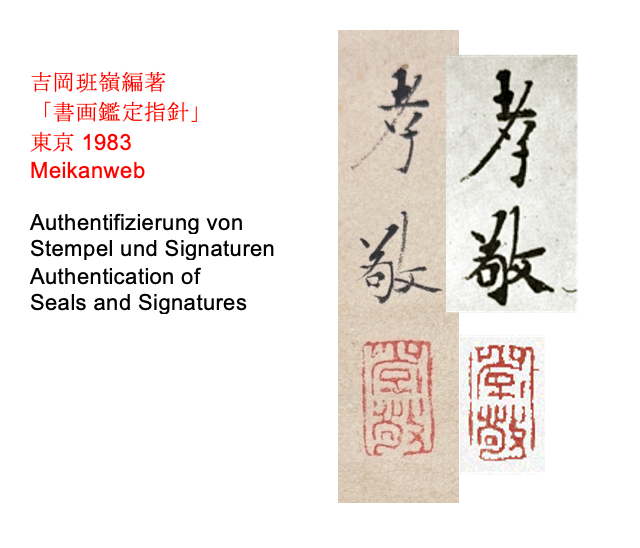
All pictures are signed and have a verifiable stamp.
Example:
In the January image, a small bird (likely a Japanese nightingale, uguisu) clings to the branches of shidare-ume (plum blossom trees with drooping limbs), which begin to bloom even during the snowfall. The bird is trying to nibble on the emerging buds – a harbinger of spring in the cold winter. Ferns are painted along the top and bottom of the image; these are traditionally part of New Year's decorations but are rarely depicted as New Year's symbols. Because ferns are white at the back, they were considered a symbol of sincerity: one has no dark underbelly, meaning one is honest and pure (white) even in secret.