

Guignard Kyoto Collection
Daruma, Round Painting | anonymous | 18th/19th Century
Daruma, Round Painting | anonymous | 18th/19th Century
Couldn't load pickup availability
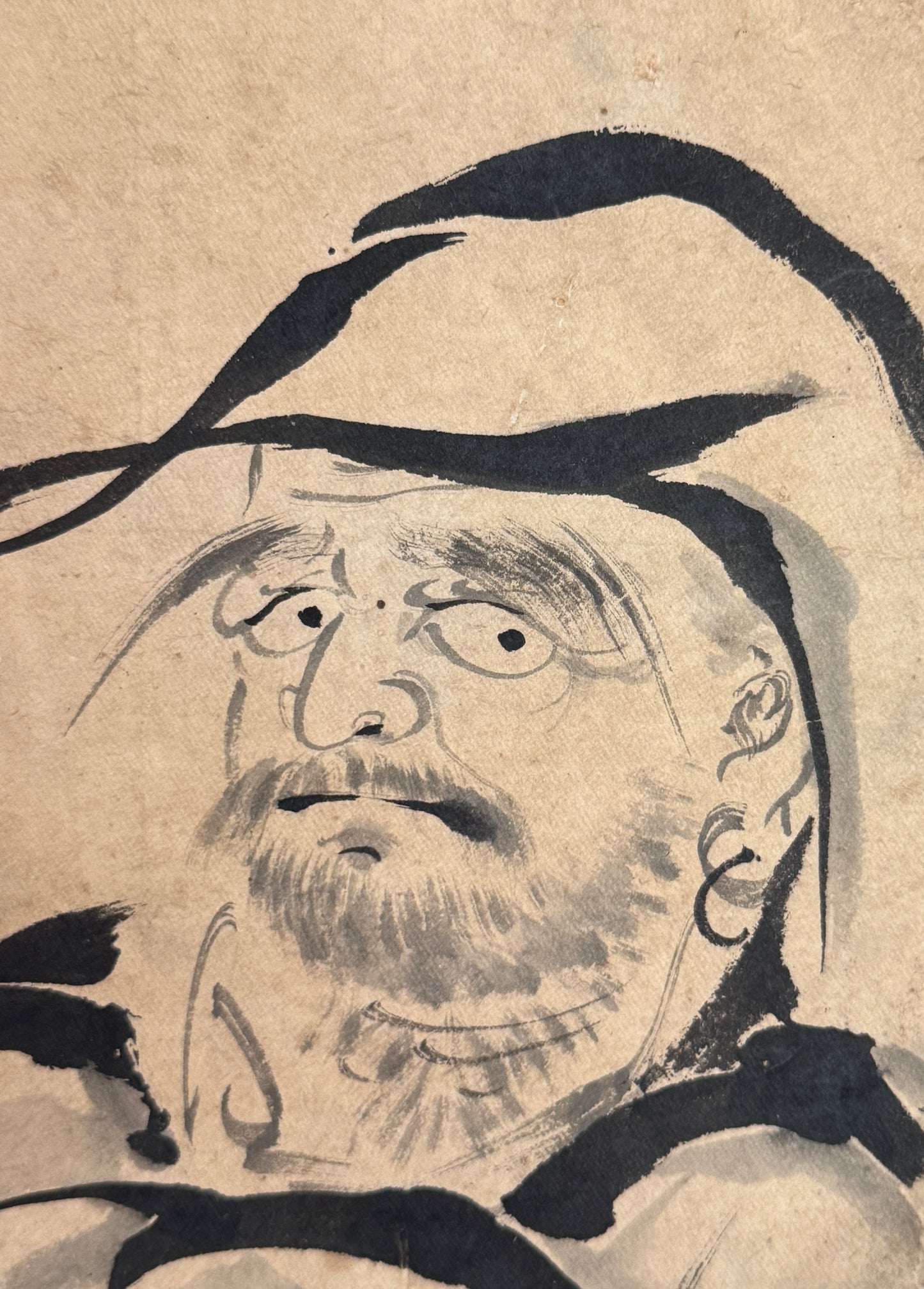
Daruma is the Zen patriarch of Japan. He is a historical figure; having arrived from India in 480, he is said to have settled in northern China, in Henan, in 523 and developed Chan Buddhism in the Shaolin Temple. Chan Buddhism only came to Japan in the 12th century, where it was called Zen Buddhism; Bodhi Dharma became Daruma. Daruma always had an exotic appearance in Japan. He had strongly curled hair (which revealed his Indian origin) and huge eyes. This wide-eyed stare is explained by the legend that Daruma, after once falling asleep during meditation, cut off his eyelids. (They fell to the ground, and from them, the tea plant emerged…)
Since its appearance in Japan, Zen has been regarded as a strong spiritual force, which is characterized not only by the consistently exaggerated facial expression but also by an intensely red robe, for which there is no historical evidence in either India or China.
In this fictional portrait, the dark brushstrokes that mark the patriarch's vestments stand out. In such black-and-white ink painting, the strong effect of the iconographically attested red robe had to be replaced by an intense ink black. It is clear that the skillfully applied brushstrokes were added later in the painting process to enhance the delicate gray with which the priest's fine facial features are formulated.
The painting was handed down unmounted and reveals only an almost invisible seal. It can be assumed that the painting is a work of the Kanō school.