

Guignard Kyoto Collection
Diptych Landscape / Crested maina on Plum blossom | Hasegawa Settan (attr.) 長谷川雪旦 (伝) | 1778-1843
Diptych Landscape / Crested maina on Plum blossom | Hasegawa Settan (attr.) 長谷川雪旦 (伝) | 1778-1843
Couldn't load pickup availability
Hasegawa Settan was primarily known as a woodblock print artist. He made a lasting name for himself with a collection of vedutas of Edo (in Edo Meishō Zue ). But like so many other visual artists of his time, he possessed diverse painting skills. Here, he moves with complete confidence in the style of ink painting, as we have known it in Japan since the 15th century. One might think this was his main medium. For it is not only the fluidity of the brush that captivates, because it seems to have arisen spontaneously in a Zen-like spirit; no, one also senses an intelligent, overarching composition of the two subjects, which is somewhat unusual as a diptych.
The curve of the branch on which the "Laughing Bird" sits (the English translation of kakachō, the Japanese ornithological name for crested myna) is mirrored in the curved line of hills in the landscape to the left. The trees in this landscape, in turn, extend away from this line, thus corresponding in their opposite movement to the branch on which the bird sits.
Thus, these two pictures truly belong together formally, even though they can be hung independently of each other, because they are perfectly balanced in themselves.
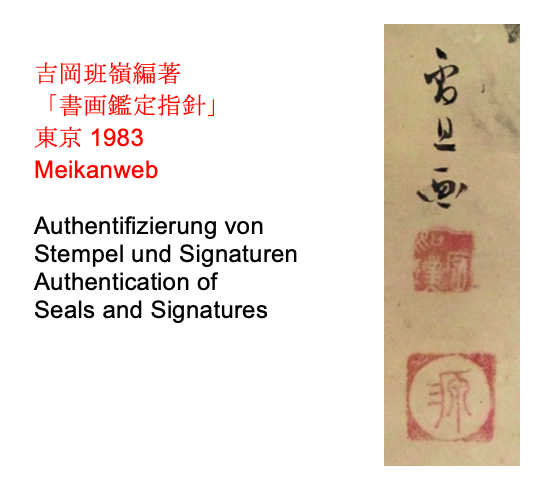
Signature and seal could not be verified, as woodblock print artists are often not found in reference works on painting, and conversely, the signatures on paintings by woodblock print artists are not recorded in reference works on woodblock print artists… In the aforementioned Edo veduta collection (in Edo Meishō Zue ), his signature is frequently found, but there the first character (unlike in this image) is always clearly written as "snow" (雪) , and thus this diptych should be considered "dedicated" to him. - The mounting shows signs of age, but is very harmonious within the ensemble.