

Guignard Kyoto Collection
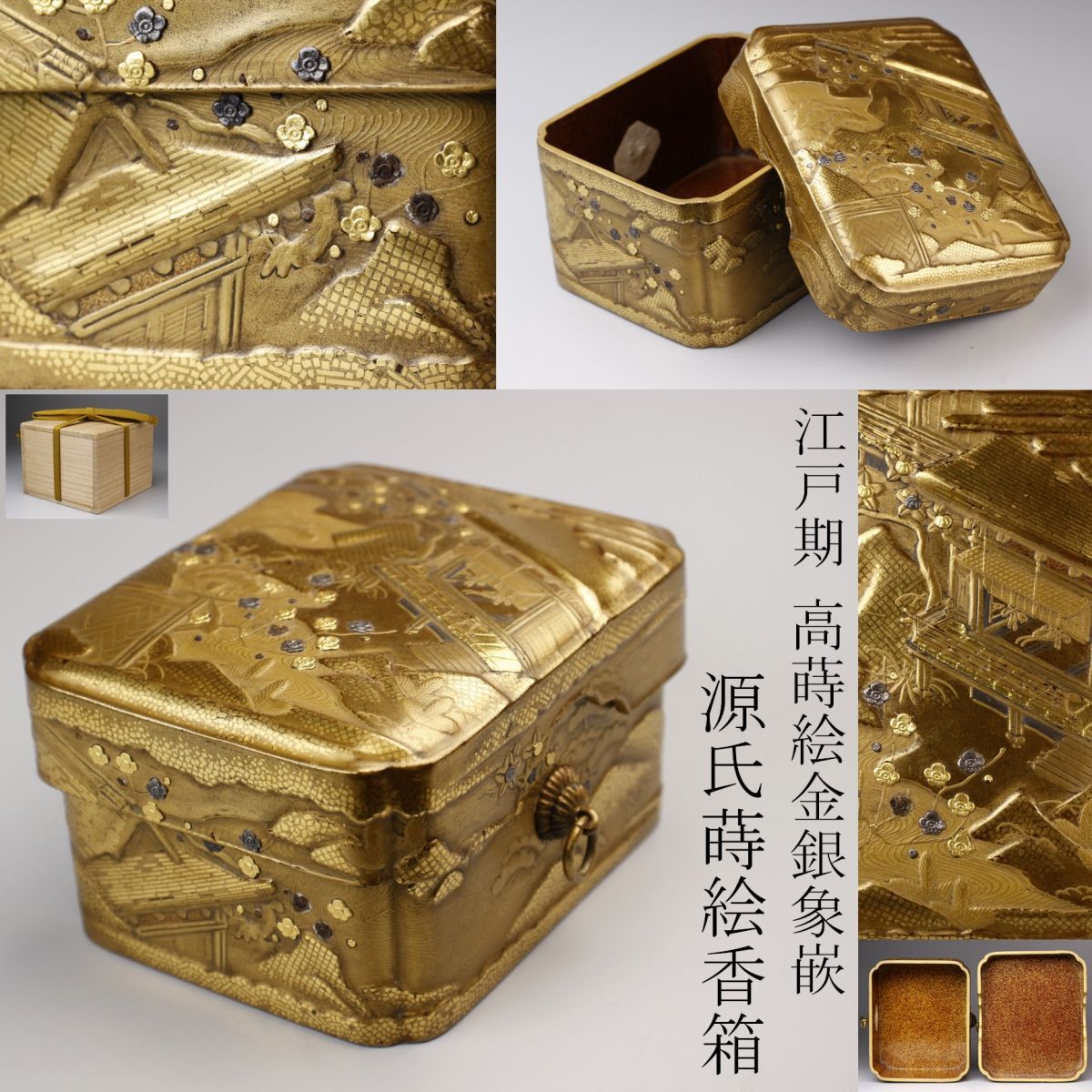
Gold-lacquered Box for Incense | anonymous | 18th Century
Gold-lacquered Box for Incense | anonymous | 18th Century
Couldn't load pickup availability
Gold makie is the most precious lacquer technique: gold dust is "sprinkled" onto still-wet lacquer – makie literally means "sprinkled picture." This centuries-old technique has been increasingly developed, so that we can also see semi-plastic forms (e.g., relief-like plum blossoms) in objects like this one. Through clever optical illusion, we even get the feeling that temple roofs project out of the picture plane. The motif of the decoration is the Tale of Genji by the court lady Murasaki Shikibu (10th/11th century). This romance novel is one of the great medieval classics, familiarity with which always indicated education. Often, in such Genji motifs in painting and handicrafts, specific chapters or scenes are referenced. In this object, in addition to the palace architecture and the rock gardens with rock formations - and a stream (obligatory for villas from the Heian period 794-1185) - we recognize the three plants whose symbolic meaning (of "long life"/"flexibility" and "new beginnings") is indispensable for New Year's celebrations: pine, bamboo, and plum blossom. However, a direct thematic connection to the Tale of Genji ends there.
This lacquer box was used to store incense. The use of differently scented incense has religious origins: every temple had (and has) its own incense fragrance. This led to a pastime in aristocratic and later in better bourgeois circles, where identifying incense became a competition linked to literary knowledge. Such events still exist today, and their ceremonial execution (kōdō 香道) is in no way inferior to an elegant tea ceremony.