

Guignard Kyoto Collection
"Clear and Distinct" mei rekireki 明歴々 | Ōmori Sōgen 大森曹玄 (Rinzai Priest) | 1904-1994
"Clear and Distinct" mei rekireki 明歴々 | Ōmori Sōgen 大森曹玄 (Rinzai Priest) | 1904-1994
Couldn't load pickup availability
Ōmori Sōgen was a Japanese priest of the Rinzai Zen school. He was head of the Tenryū-ji lineage in Arashiyama and became president of Hanazono University in Kyoto in 1945.
The calligraphic maxim on this hanging scroll is popular amongst Zen priests. Particularly within this spiritual and religious discipline, the call for ‘clarity and distinctness’ (which one associates with notions of logical debate) may perhaps seem surprising at first glance. However, the Zen understanding of clarity and distinctness refers to a mind purified through meditation, which intuitively and instantly recognises the world and existence in their true nature.
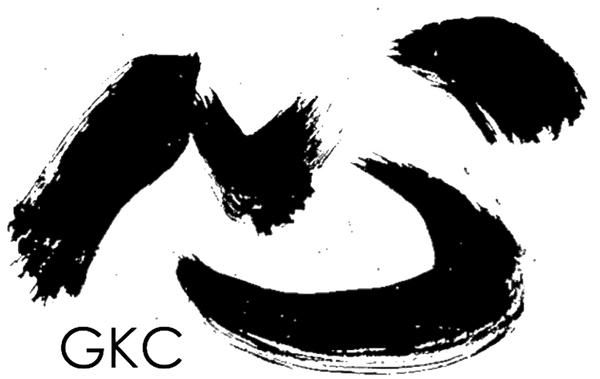
The most important character for Ōmori Sōgen in this maxim is the first one: 明. It is a combination of the sun 日 and the moon 月. Together, these two celestial bodies symbolise brightness. It is surprising, then, that the calligrapher distorts the character so significantly - one might say he renders it „indistinct“. The sun component 日 looks like a mouth 口, and for the averagely educated observer, there is little to recognise of the moon 月.
Yet calligraphy is not, after all, „writing as a means of accurate communication“. Calligraphy aims to transcend the „vehicle of communication“ that a written character represents – not to convey information about a content, but to make it tangible to the mind and soul. Here, the left-hand half represents, as it were, merely an opening from which light suddenly escapes in a strand-like brushstroke. (A note on this strand-like connection: the calligrapher lived in the 20th century and, as an educated person, must have been aware that the moon only shines because it receives light from the sun. Whether he was aware of this whilst practising calligraphy cannot, of course, be verified.)
Through the deep black arch, we perceive a glow that this black arch - extending almost back to the opening on the left – encloses. Here, the concept of „bright“ is not written using 明 (the sun-moon combination), but is rendered perceptible as a source of light through an empty form.
The considerably more complex character for ‘clear’ 歴 is rendered to the left of it in a much smaller size and (despite sweeping simplifications) more unambiguously as a written character. Its repetition is a commonly used abbreviation in writing: 々.