

Guignard Kyoto Collection
Calligraphy endurance nin 忍 „One character is worth 1,000 gold pieces“ | Gesshū Sōko 月舟宗胡 | 1618 - 1696
Calligraphy endurance nin 忍 „One character is worth 1,000 gold pieces“ | Gesshū Sōko 月舟宗胡 | 1618 - 1696
Couldn't load pickup availability
Gesshū Sōko was a Zen priest of the Sōtō sect. In terms of his training, he belonged to the Ōbaku school. This school consisted mainly of priests who had fled China at the end of the Ming period (1368 -1644) and found refuge and a warm welcome in Kyoto. These Chinese monks brought a new style of calligraphy to Japan. One such style involves the depiction of a maxim in which the first character is written very prominently. In principle, the aesthetic appreciation of such calligraphy then focuses primarily on this first character.
Here, it is the character for ‘endurance, perseverance’. The character consists of two parts. The upper part is decisive for the reading ‘nin’ of the character. Yet I am also intrigued by its meaning: ‘blade’. The lower part of the character means ‘heart’. I cannot say for certain whether the interpretation ‘cutting the heart with the blade’ (i.e. enduring mental and physical pain) is scientifically valid in terms of the character’s etymology, but it is tempting.
Calligraphers, too, are often creative in their interpretation of the composition of character elements – it is not uncommon for them to omit elements if this enhances the brushwork achieved.
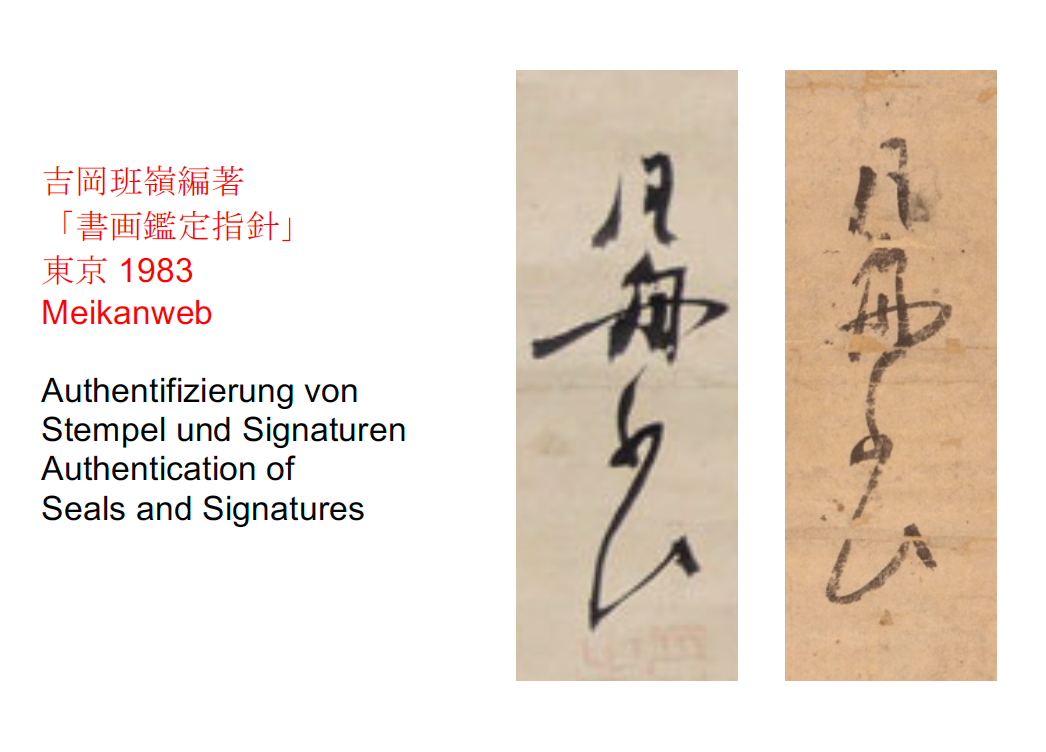
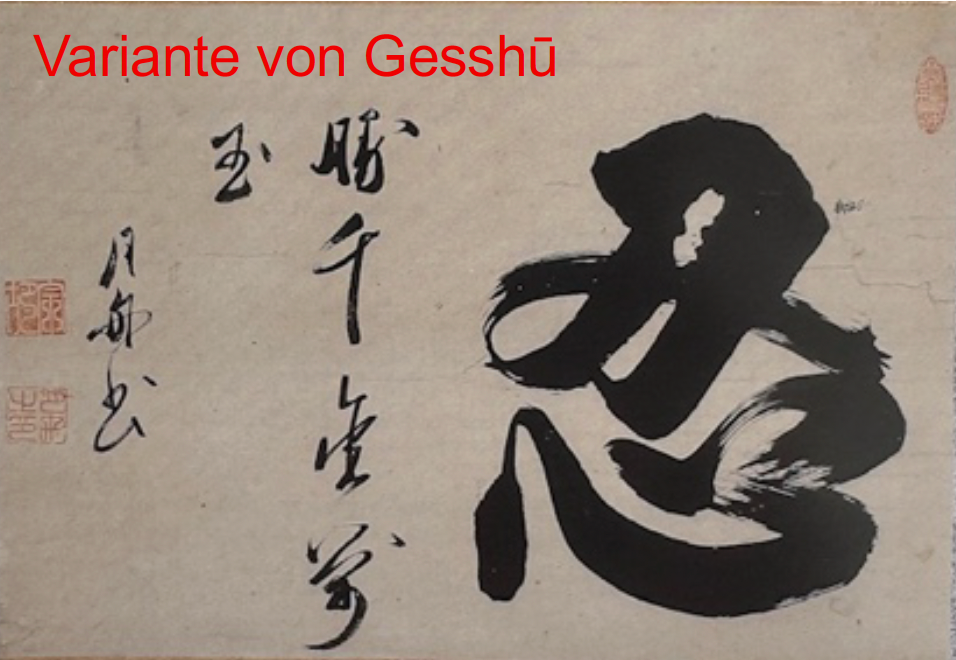
In this image, two additional dots (splashes) have been added in the top right-hand corner. A comparison with another calligraphic example of this character by the same priest, where these dots are absent, seems to support this assumption conclusively. Furthermore, this additional calligraphic example helps to capture the original brushwork of the priest-painter and provides a point of authentication: The lower parts of the character, i.e. the ‘heart’ element, are almost identical.
The Sōtō school, with its strict rules, was the most popular Zen sect amongst the samurai. The concept of ‘endurance’ was particularly important to them; it is central to the mindset of the Japanese knights. In this calligraphy in particular (even more so than in the one consulted), the brushwork in the upper part has a distinctly ‘masculine’ quality, which is more expressive when conveying the idea of a ‘(sword) blade’ than in the elegant, curved character of the comparative example.