

Guignard Kyoto Collection
Calligraphy Kotobuki 寿 and Bat | Kishi Koma (Ganku) 岸駒 | 1756-1838
Calligraphy Kotobuki 寿 and Bat | Kishi Koma (Ganku) 岸駒 | 1756-1838
Couldn't load pickup availability
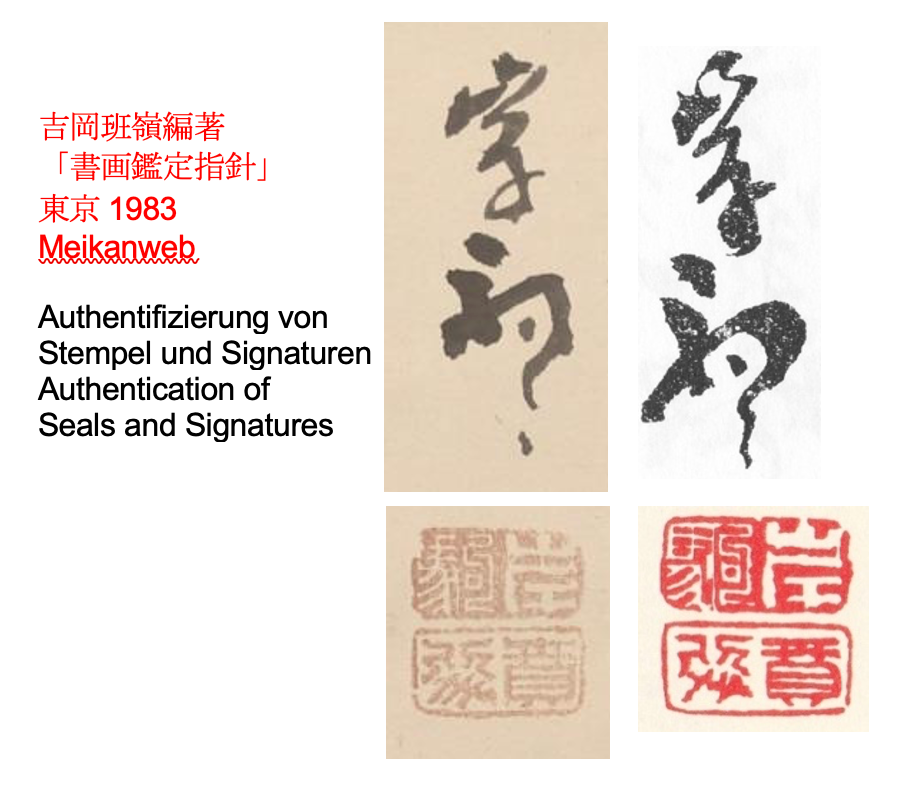
Kishi Koma is best known as a tiger painter, as he was the first and only artist permitted to study and paint a tiger in the Shogun's garden. He was capable of highly precise, realistic painting, but his signature reveals that a freer, more sketch-like brushstroke better suited his true nature. This is particularly evident in this painting, in the seemingly casual brushstroke of a bat. Bats have a fluttering flight pattern—they can change direction in the blink of an eye. For depicting such a creature in flight, a wild, free brushstroke is very appropriate.
The Chinese word for bat is "biānfú," written with two two-part characters , 蝙蝠. Both character sets begin with the so-called "beetle radical"虫, indicating that we are dealing with a beetle-like creature. The second part of the first character, "biān," can mean "friendly, soft." The second character, "fú," contains (after the beetle radical虫) the character for "wealth." Thus, "Whoever is well-disposed toward wealth is happy"—a very Chinese conclusion, and so the bat has been considered a symbol of good fortune since ancient times.
It is rare to find the character for longevity, kotobuki, combined with the Chinese symbol of good fortune, the bat, in Japanese calligraphy. It is surprising, however, that Kishi Koma, in such a combination with the bat, does not use the old (Chinese-inspired) form of kotobuki (壽), which is quite complex and contains many strokes, but rather prefers the modern, simpler version (寿) . This likely stems from the painter's preference for using the brush freely and spontaneously, which could pose problems for the meticulous calligraphic rendering of a character with 14 strokes…