

Guignard Kyoto Collection
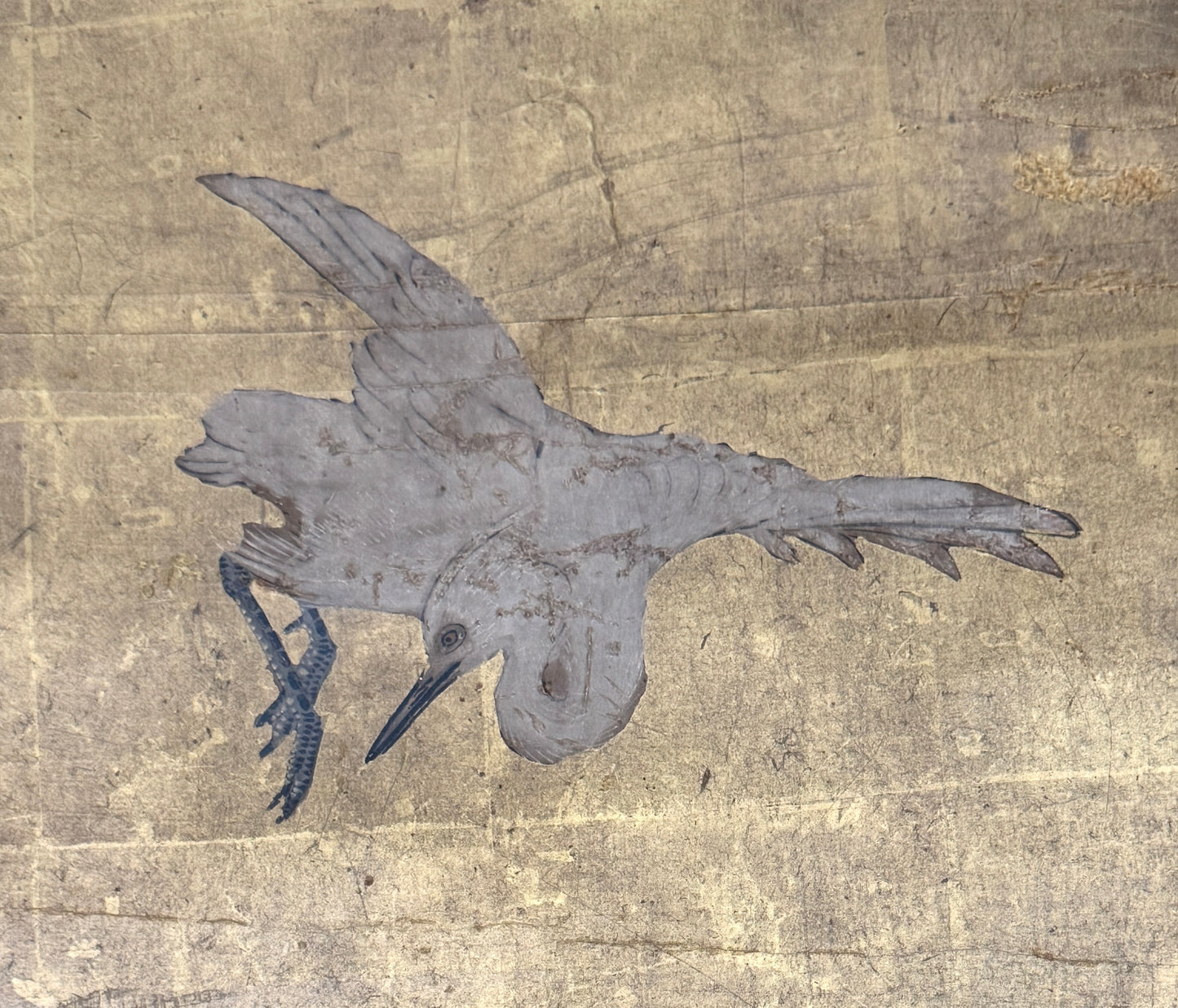
Egret and Peonies on a Gold Ground | anonymous | 18th Century
Egret and Peonies on a Gold Ground | anonymous | 18th Century
Couldn't load pickup availability
This image probably comes from a multi-panel screen – only a single picture has survived. It is unsigned, which was quite common in the 17th/18th century, even if the authorship would have been worth mentioning. Stylistically, one is most likely to think of the Kanō school, which has been supplying palaces and large temples with magnificent sliding door and screen paintings since the 15th century.
The use of gold as a background is not just a matter of the desire for splendor. The interiors of temples and castles tended to be quite dark. Gold, however, reflected sparse sunlight or candlelight and created a warm atmosphere in the room. In old gildings, like this one, the shapes of the square foils used for gilding clearly stand out and vividly structure the shimmering surface.
In this painting, the gold plane is not just a background; at the top, in the middle, and at the bottom, cloud formations are hinted at, which are, however, completely unreal – they have an exclusively decorative function. This concise graphic element contrasts with the various levels of realism in the reeds and peonies in the lower part of the painting. The drawing of the reed leaves is very realistic – not so much their color: one would actually expect a fresh green at the time when the peonies bloom. The leaves of the peonies are also green in principle, but a central leaf at the bottom takes on the unreal beige of the reed leaves, which makes it clear that the painter thinks purely pictorially: He needs a bright counterbalance to the white egret in the golden sky. The egret is completely isolated in the depiction and therefore compactly rendered: With its open wingtips and black feet, it is inscribed in a triangle, which as a geometric form always promises graspability and stability.
The white egret in Asia is a symbol of spirituality, purity, and harmony. The peony is a symbol of splendor and wealth. Both elements together ensure happiness and well-being in life.
The painting may no longer be as brilliant as it was 250 years ago. But it is precisely the patina that creates an expression of nobility, which also determined the remounting: a noble pine-needle green with a fine brocade frame is intended to frame the painting with tranquility and elegance.