

Guignard Kyoto Collection
Prince Shōtoku at Sixteen 聖徳太子 | anonymous | ca. 1850
Prince Shōtoku at Sixteen 聖徳太子 | anonymous | ca. 1850
Couldn't load pickup availability
There is no Japanese person who does not know Shōtoku Taishi (607–672). His likeness used to appear on the 10,000-yen bill. Every year in early April, the Shitenō Temple in Osaka hosts the most magnificent performance of court dances (bugaku) as part of a major Buddhist ceremony honoring the anniversary of his death.
Shōtoku Taishi is regarded as the political and spiritual father of the Japanese nation. Before Japan connected with the world cultures of China (and Korea), it was an archipelago consisting of hundreds of small principalities. Shōtoku Taishi’s goal was to create a unified state capable of reaching the cultural level of China. He knew that Buddhism was the key to this. With this in mind, he promoted this religion on a grand scale, for Buddhism not only introduced a new worldview and metaphysics to Japan but also sciences such as medicine, engineering, architecture, and various arts.
The reverence for this cultural father of the nation went so far that he was venerated as a child prodigy - even as a boy, he is said to have demonstrated extraordinary abilities. At the age of sixteen, Shōtoku Taishi is said to have prayed for his ailing father, Emperor Yōmei, and burned incense for him at the temple, an act that served as a model of Confucian filial piety (孝 kō) toward his father. In this portrait, he is holding an incense burner, such as those still used today by Buddhist priests. His hair is pinned up in a boy’s hairstyle to emphasize that he is depicted here as a young man and not yet as an adult statesman.
The high esteem in which Shōtoku Taishi is held is also evident from the pedestal on which he stands: the base resembles an altarpiece.
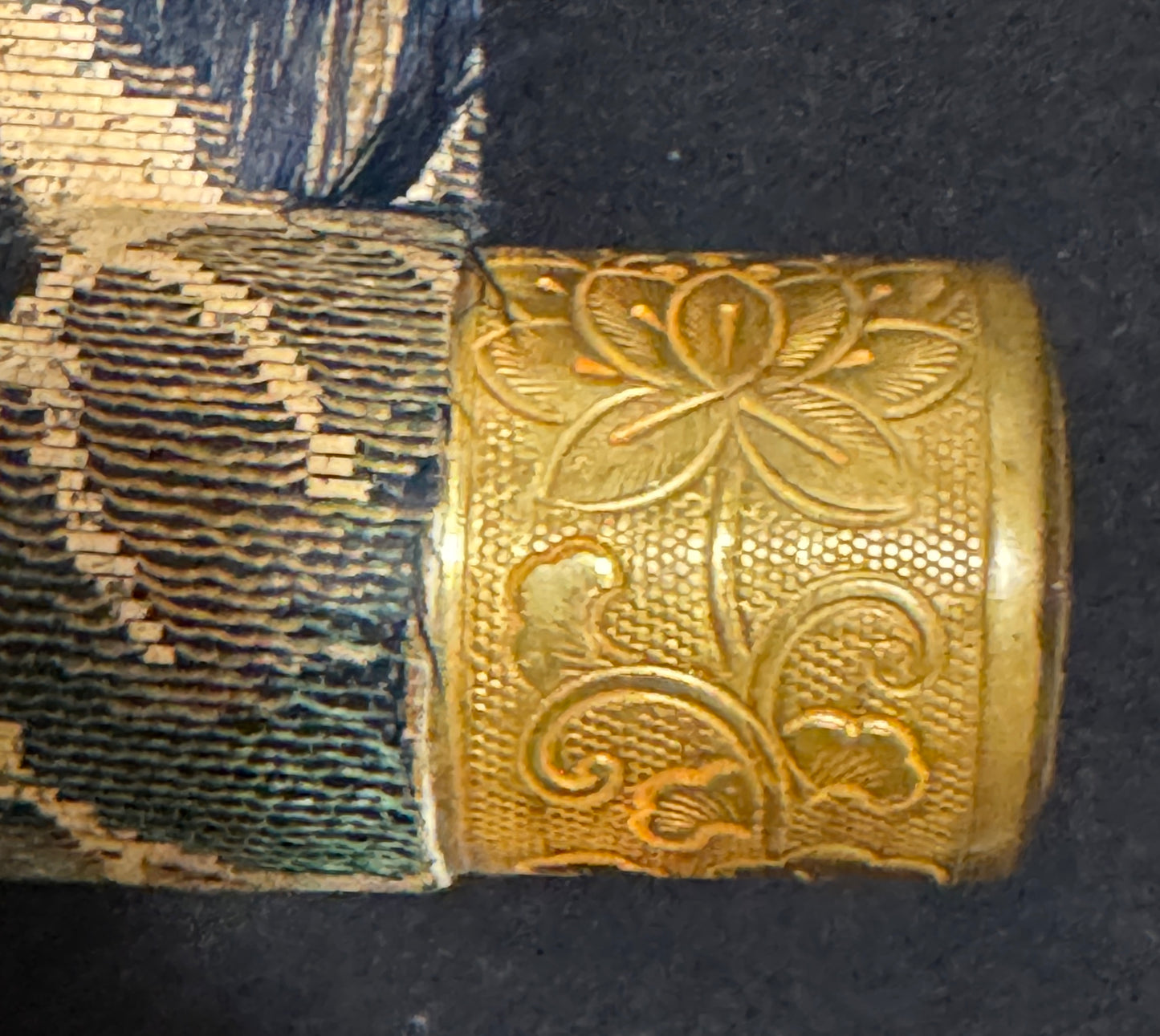
The painting was damaged, and all the gold elements had to be replaced. The original silk mounting is particularly precious - it is of unsurpassed splendor - and the scroll mounts are decorated with finely embossed brass. The original box is also very special: it is made of ebony (kokutan), the most expensive wood in Japan.