

Guignard Kyoto Collection
Seated Amida Figure 阿弥陀如来 | Anonymous | Mid-Muromachi period (15th century)
Seated Amida Figure 阿弥陀如来 | Anonymous | Mid-Muromachi period (15th century)
Couldn't load pickup availability
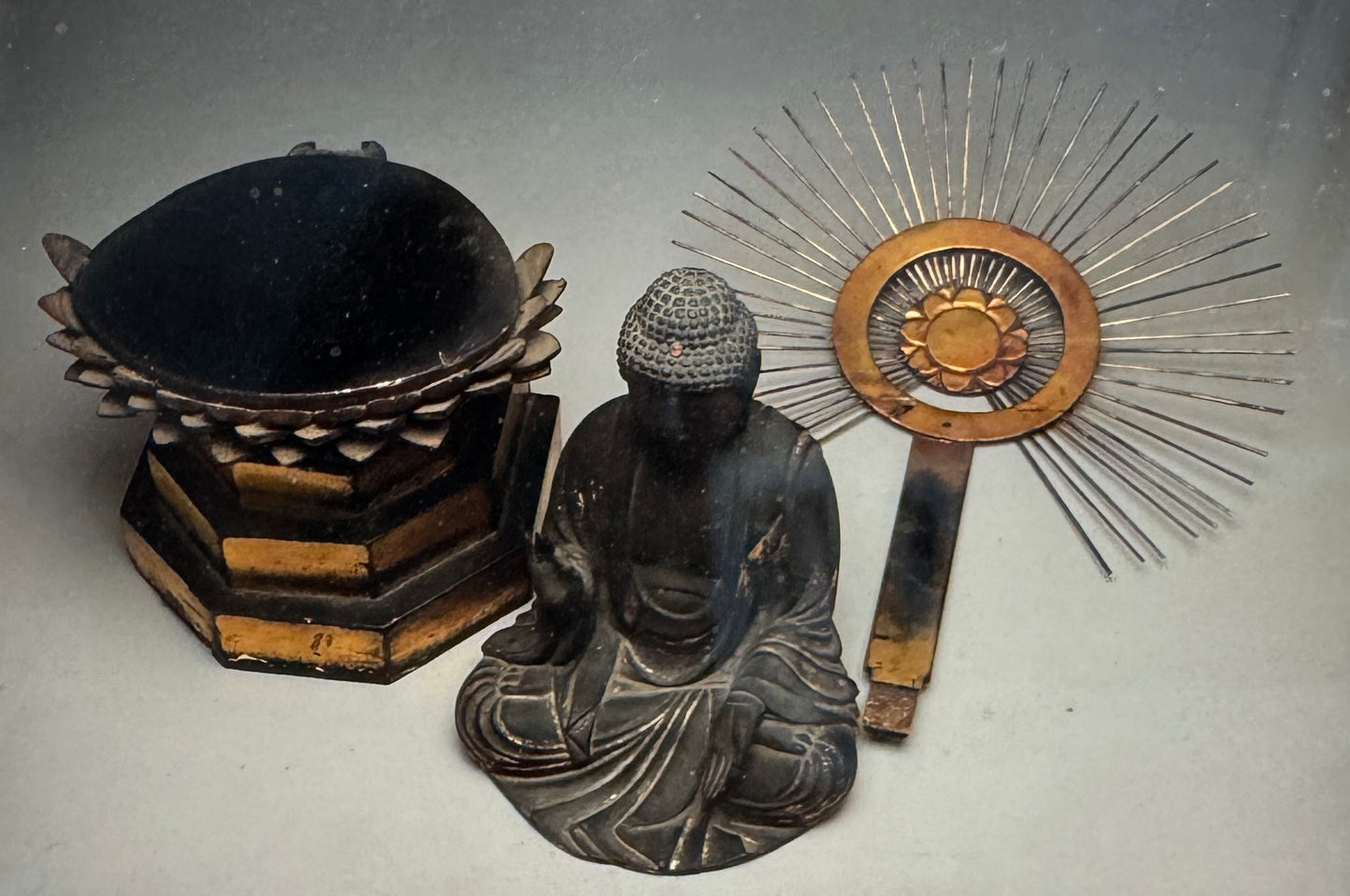
The sculpture originates from Tokushima, a province far from Kyoto. The figure itself displays the elegance and finesse characteristic of Kyoto sculptors of that period. The lotus pedestal, however, is somewhat simpler in design – it is possible that it was (re)created later (no later than the 17th century) for the sculpture in Tokushima. For the experts at the restoration workshop in Kyoto, Tomita Kōgei, there are elements of the ensemble that support the assumption that the Buddha figure, on the one hand, and the entire base of the Buddha statue, on the other, differ in origin and period – a fact frequently encountered in ancient Buddha installations. The seated Buddha figure can, of course, also be displayed without the stepped base and the halo, as the parts can all be easily separated from one another.
Amida Nyorai 阿弥陀如来, or Amitabha, is the ‘Buddha of the Pure Land’.
The interpretation of his hand gesture is somewhat complicated:
His right hand, with the thumb touching the index finger, indicates (when viewed in isolation) the gyan-mudra, a hand gesture signifying concentration of the mind or meditation. However, this mudra is also regarded as a variation of the semuiin 施無畏印 (a hand gesture in which all fingers are extended).
The left hand forms the yoganin 与願印, a hand gesture symbolising the fulfilment of the wish for bliss. When frequently combined, semuiin and yoganin are regarded as the abhaya mudra, a greeting gesture signifying‘divine protection and bliss’.
(In the iconography of hand gestures (mudra), there are often differing interpretations; a claim to unambiguity cannot often be fulfilled.)
Viewed as a work of art, the sculpture is compelling in its coherence. The subtly suggested relaxed posture of the upper body influences the gentle flow of all the folds in the robe and the harmony of the body’s parts. The hands are very delicately crafted, and the face, with its inlaid crystal eyes, radiates an incredible sense of peace and a wonderful tranquillity.
This Amitabha figure must have been treated with great reverence over the centuries – it is preserved in almost immaculate condition and therefore required hardly any restoration, which is exceptional for a wooden sculpture created a good 500 years ago.
A box made of paulownia wood was specially crafted for the statue and the rest of the ensemble, ensuring that all the pieces can be stored safely and securely.