

Guignard Kyoto Collection
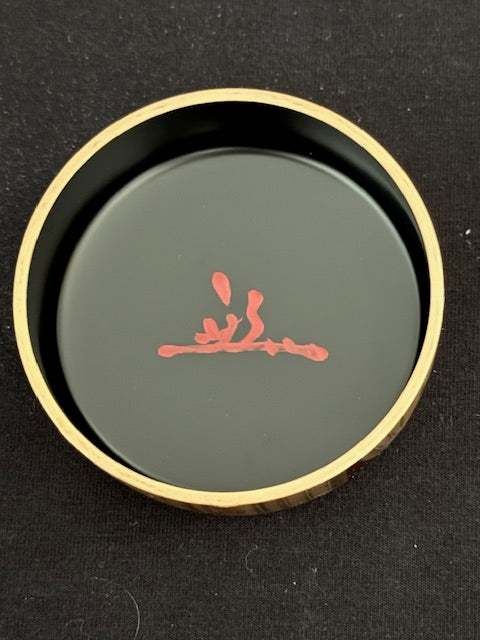
Willow on Natsume (tea caddy) | Nakayama Yukihiko 中山幸比古 | 1956 -
Willow on Natsume (tea caddy) | Nakayama Yukihiko 中山幸比古 | 1956 -
Couldn't load pickup availability
Lacquer master Yukihiko Nakayama was highly successful even in his youth. At the age of 26, he was named a "National Treasure", an honor usually reserved for established, successful artists. In 1993, he collaborated with the piano company Kawai, decorating a grand piano with phoenix motifs as a wedding gift for Princess Masako. Two years later, he was commissioned to create lacquerwork for the Kasuga Shrine in Nara, and in 2000, he held a solo exhibition of his lacquer work in Manhattan.
Even without this background information, it's immediately apparent that this lacquer work is exceptionally artistic and rich in its execution. The maki e technique used to create this object is fundamentally very old; it was adopted from China but soon refined and developed in Japan. Maki e actually means "scattered picture." The process involves painting with a lacquer-soaked brush onto a dry layer of lacquer. Gold dust is then sprinkled onto the still-wet drawing. Later, however, gold or colored lacquer was also used, and colored lacquer was applied directly onto the lacquer. It's quite likely that we're dealing with a lacquer painting here, even though the wooden box refers to maki e – meaning a "scattered picture."
The motif of the weeping willow (yanagi ) is popular – but the tree is not associated with "mourning" in Japan. Willows traditionally stood at the ends of bridges, i.e., at a place of "crossing over." Thus, yanagi is a symbol of "saying goodbye." In extreme cases, it is a symbol of "passing on to the afterlife."
A more earthly aspect of yanagi is its association with beautiful girls. The long branches of the willow react sensitively to every breath of wind – such delicacy is also expected of the soul of a charming woman. A young girl's kimono is called furisode , "swinging sleeves," because these long sleeves are meant to move as gracefully as willow branches in a spring breeze when a girl walks.
From this elegant perspective, it is not surprising that precious tea caddies are often decorated with a willow pattern.